ZEISS Loxia 85mm f/2.4 Sony E
 Zeiss
ZeissEAN:4047865500210
₦ 2,321,693.46
VAT Included
VAT Included
Available in 20 days
E-Mount Lens/Full-Frame Format
Aperture Range: f/2.4 to f/22
Three Low Dispersion Elements
Sonnar Optical Design
ZEISS T* Anti-Reflective Coating
Manual Focus Design
Manual Aperture Ring Can Be De-Clicked
Weather-Sealed Construction
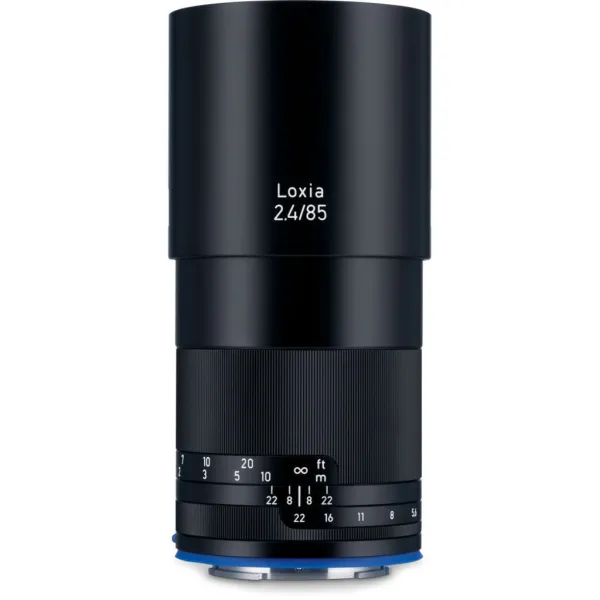
A compact short telephoto prime for full-frame Sony E-mount mirrorless cameras, the Loxia 85mm f/2.4 from ZEISS is an ideal portrait-length lens characterized by its sleek form factor and impressive optical qualities. Utilizing an optimized Sonnar concept, the simple seven elements, seven groups design incorporates three anomalous partial dispersion elements to greatly reduce chromatic aberrations and color fringing for notable clarity and color accuracy. Additionally, a ZEISS T* anti-reflective coating has also been applied to the individual lens elements to control lens flare and ghosting for improved contrast when working in strong lighting conditions.
Loxia-series lenses are distinguished by their manual focus operation along with a manual aperture ring that can be de-clicked for silent operation, making them especially suitable for filmmaking applications. Loxia lenses are also characterized by their compact form factor and all-metal lens barrel, which incorporates engraved focusing and depth of field scales, for fine-tuned control. Additionally, the lens body sports a dust- and moisture-sealed design to permit its use in trying environments.
Short telephoto prime is designed for full-frame Sony E-mount mirrorless cameras, however can also be used with APS-C models where it provides a 127.5mm equivalent focal length
An f/2.4 maximum aperture permits working in low-light conditions, offers control over depth of field, and also helps to maintain the compact overall form factor of the lens.
Sonnar optical concept suits the combination of a large maximum aperture and long focal length, and also contributes to notable sharpness, well-controlled flare, and high contrast.
Three anomalous partial dispersion elements are used to significantly reduce color fringing and chromatic aberrations for increased clarity and color fidelity.
ZEISS T* anti-reflective coating has been applied to each lens surface to help minimize reflections and provide greater contrast and color fidelity.
Manual focus design is benefitted by focusing and depth of field scales along with a 220° focus ring rotational angle and hard stops at both infinity and minimum focusing positions.
Manual aperture ring has clicked indicators throughout aperture range. Using the included De-Click Tool, this ring can be mechanically 'de-clicked' for smooth, silent rotation throughout the aperture range, making it ideal for video applications.
Weather-resistant construction includes internal seals to guard against dust and moisture as well as a blue sealing ring at the lens mount to protect the lens-camera interface.
The lens mount is fitted with an electronic interface that conveys all lens Exif data to the camera and can also be configured to automatically activate the camera's focusing magnification function when turning the focus ring.
Aperture Range: f/2.4 to f/22
Three Low Dispersion Elements
Sonnar Optical Design
ZEISS T* Anti-Reflective Coating
Manual Focus Design
Manual Aperture Ring Can Be De-Clicked
Weather-Sealed Construction
A compact short telephoto prime for full-frame Sony E-mount mirrorless cameras, the Loxia 85mm f/2.4 from ZEISS is an ideal portrait-length lens characterized by its sleek form factor and impressive optical qualities. Utilizing an optimized Sonnar concept, the simple seven elements, seven groups design incorporates three anomalous partial dispersion elements to greatly reduce chromatic aberrations and color fringing for notable clarity and color accuracy. Additionally, a ZEISS T* anti-reflective coating has also been applied to the individual lens elements to control lens flare and ghosting for improved contrast when working in strong lighting conditions.
Loxia-series lenses are distinguished by their manual focus operation along with a manual aperture ring that can be de-clicked for silent operation, making them especially suitable for filmmaking applications. Loxia lenses are also characterized by their compact form factor and all-metal lens barrel, which incorporates engraved focusing and depth of field scales, for fine-tuned control. Additionally, the lens body sports a dust- and moisture-sealed design to permit its use in trying environments.
Short telephoto prime is designed for full-frame Sony E-mount mirrorless cameras, however can also be used with APS-C models where it provides a 127.5mm equivalent focal length
An f/2.4 maximum aperture permits working in low-light conditions, offers control over depth of field, and also helps to maintain the compact overall form factor of the lens.
Sonnar optical concept suits the combination of a large maximum aperture and long focal length, and also contributes to notable sharpness, well-controlled flare, and high contrast.
Three anomalous partial dispersion elements are used to significantly reduce color fringing and chromatic aberrations for increased clarity and color fidelity.
ZEISS T* anti-reflective coating has been applied to each lens surface to help minimize reflections and provide greater contrast and color fidelity.
Manual focus design is benefitted by focusing and depth of field scales along with a 220° focus ring rotational angle and hard stops at both infinity and minimum focusing positions.
Manual aperture ring has clicked indicators throughout aperture range. Using the included De-Click Tool, this ring can be mechanically 'de-clicked' for smooth, silent rotation throughout the aperture range, making it ideal for video applications.
Weather-resistant construction includes internal seals to guard against dust and moisture as well as a blue sealing ring at the lens mount to protect the lens-camera interface.
The lens mount is fitted with an electronic interface that conveys all lens Exif data to the camera and can also be configured to automatically activate the camera's focusing magnification function when turning the focus ring.
Accessories for ZEISS LOXIA 85MM F/2.4 SONY E
Filters Round - Filters Round 52mm
Tiffen - 52mm Circular Polarizing Filter
₦ 104,161.65
VAT Included
VAT Included
Tiffen - Filter 52mm Digital Neutral Density Kit
₦ 127,920.67
VAT Included
VAT Included
Tiffen - 52mm Photo Twin Pack (UV Protection and Circular Polarizing Filter)
₦ 44,130.28
VAT Included
VAT Included
Tiffen - Kit Photo Essentials-52mm - Polarizing, UV Protector, 812 Color Warming
₦ 75,547.60
VAT Included
VAT Included
Tiffen - 52mm UV Protector
₦ 130,052.91
VAT Included
VAT Included
Tiffen - 52mm Variable Neutral Density
₦ 194,393.69
VAT Included
VAT Included